Fireblocking vs draftstopping: what it means on an inspection
Fireblocking is material that closes hidden spaces in walls, soffits and stairs so fire and hot gases cannot travel through them unchecked. Draftstopping divides large, open floor-ceiling or attic cavities into smaller areas so air and fire cannot run the whole length. Fireblocking closes small spaces, and draftstopping subdivides big ones.
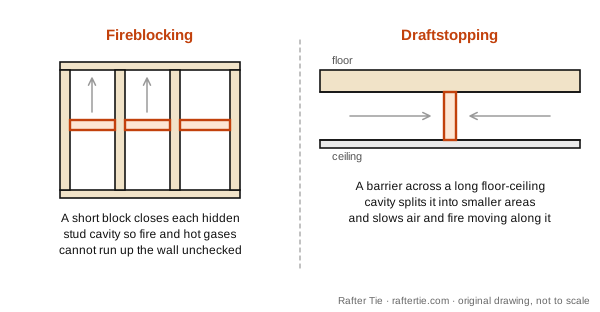
Use this diagram
How to tell which one you are looking at
- Look at the cavity. A narrow concealed space such as a stud bay, a soffit, a furred wall or the space beside a stair stringer calls for fireblocking. A wide open concealed space, such as the cavity between a floor and the ceiling below it in a large area, calls for draftstopping.
- Look at where fireblocking goes. Typical locations are the top and bottom of stud walls at ceiling and floor levels, at set intervals along tall walls, in soffits and drop ceilings, at the top and bottom of stair stringers, and around pipes, vents and ducts where they pass through floors and ceilings. The section lists them all; read it for your edition.
- Look at the material. The code lists the allowed fireblocking materials. Solid lumber of a minimum thickness is a familiar one, and the list also names sheet materials and others. Ordinary insulation is not automatically fireblocking; only the materials the code lists, installed the way it says, count.
- Look at where draftstopping goes. It divides floor-ceiling assemblies where there is usable space both above and below the cavity, and the section lists the other conditions and sets an area limit for each section of cavity.
- Check penetrations. A hole through a fireblock or draftstop for a pipe or wire must be sealed with an approved material. An open hole defeats the block.
Try one question
Question 1 of the free 10-question check on ICC B1. No signup. Then ask Plumb, the AI study assistant, why the answer is right and the others are wrong.
Public Safety and Special Construction
In a new bedroom, the only emergency escape window has a keyed sash lock, with the key hanging on a hook beside the window. What should the inspector do?
Press A-D or 1-4 to choose an answer while this question is on screen.
Choose an answer to begin
Common mix-ups
- Fireblocking versus firestopping. Firestopping is the sealing of a penetration through a fire-rated assembly with a listed system. Fireblocking is a general barrier in a concealed space. The words are close and the rules are separate.
- Draftstopping versus fireblocking in a stud wall. In a stud wall the question is fireblocking. Draftstopping is about large horizontal cavities.
- Both are not the same as a fire-resistance rating. Fire-rated walls and floors are a separate subject with their own assemblies.
Ask Plumb before you buy AI your AI study assistant
See what's on the ICC B1 exam, test yourself with 5 quick questions, or find the plan that fits you.
The ICC B1 course
Available now · instant accessLearn how the IRC is laid out, drill finding sections fast, then practice. Written for the 2024 IRC.
- 7modules of lessonsEvery task on the outline
- 4full-length timed exams60 questions in 120 minutes each
- 426practice questionsEach one explained
- 4worked calculationsStep by step
- 8timed code lookups a setFind it fast in IRC, with your median time
- 1week-by-week study planSet to your exam date
Turn a practice answer into a study step. In untimed practice, ask Plumb AI about any question you answer, follow up, then see your weakest topics and what to drill next.
Instant access. Terms and refunds · Secure checkout by Stripe · Billed by Nori Software
Every answer comes with a full explanation.
Fireblocking and draftstopping on the B1
Fireblocking is listed under wall construction, which is 27% of the B1, and the fire protection provisions are in Chapter 3. The two terms are easy to swap, so the exam favors questions that give a location and ask which one applies. Find both by name in your table of contents, tab them side by side and confirm the section numbers in your edition, since some Chapter 3 numbers changed in 2024.
Practice it
Train the lookup with the code navigation drill. Then read band joist and cripple wall, which both create concealed spaces at the floor line, and return to the IRC terms glossary for the next term.
Know your fire protection? Check the rest of the B1
Take the free 10-question check. It is weighted to the seven B1 areas, scored by area and needs no signup, so you see which area costs you the most points. The Rafter Tie course adds timed practice exams, a lesson for each outline area and a study plan built from your exam date.
Sources
Show the list
- B1 Residential Building Inspector Content Outline, International Code Council.
- 2021 IRC contents and 2024 IRC contents, International Code Council. Chapters are named, not quoted; open your own copy for the text.
Facts come from the sources listed above. If something has changed, tell us and we will correct it within 2 business days.
Your next step
Ready to see where you stand on ICC B1?
Free, untimed and scored by domain. No signup.
Start the free 10-question checkB1 course with IRC navigation drills. Lessons, timed practice exams and a plan around your exam date. Get B1 course with IRC navigation drills · $99 See the plans or read the free sample lesson.Terms and refunds
Want a timed run? Try the free 25-question mini-mock. The first 5 need no email.
Prefer paper? Free printables
- Print the study checklist (free PDF). Topics to cover, on one printable page. No email.
- Print a class quiz (free PDF). 5 practice questions with an answer key on page 2.
- Print the flashcards as cut-out cards (free PDF). The free flashcard sample, ready to cut and carry.
From the blog
- ICC B1 wall framing, headers and masonry topics
- ICC B1 roof and ceiling construction: what to know
- ICC B1 exterior coverings and weather barriers