Band joist: what it means on an inspection
A band joist, also called a rim joist, is the board that runs along the outside edge of a floor frame and closes the ends of the floor joists. It keeps the joists upright, ties them together and carries the load of the wall above down to the sill plate. Without it the joist ends would be open and unsupported.
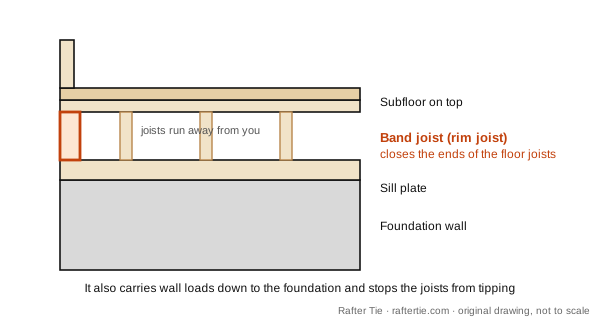
Use this diagram
How to check the band joist
- Find it. Look along the edge of the floor frame, above the sill plate. The board that runs the length of the edge, across the ends of every joist, is the band joist.
- Check that it closes the joists. It should run continuously along the edge and be fastened to the end of each joist, so the joists cannot roll over and the edge is closed.
- Check its bearing. It should sit on the sill plate or on the support below, not hang past it. The wall above bears on it through the subfloor, so it is a load path member.
- Look at the size. A band joist is usually the same depth as the joists. Where engineered rim board is used, it should be installed per the product instructions, because it is rated for load transfer.
- Watch for cuts. Holes and notches for pipes and ducts weaken the board, and it carries the wall above, so never assume a cut in a band joist is harmless because it is small. Engineered rim board follows its maker's rules for holes.
Try one question
Question 1 of the free 10-question check on ICC B1. No signup. Then ask Plumb, the AI study assistant, why the answer is right and the others are wrong.
Public Safety and Special Construction
In a new bedroom, the only emergency escape window has a keyed sash lock, with the key hanging on a hook beside the window. What should the inspector do?
Press A-D or 1-4 to choose an answer while this question is on screen.
Choose an answer to begin
Common mix-ups
- Band joist versus floor joist. Floor joists run across the floor and carry its load to the beams and walls. The band joist runs along the edge and closes their ends.
- Band joist versus header joist. At a floor opening such as a stairwell, short framing members called headers and trimmers frame the hole. They are not the band joist at the edge.
- Band joist versus sill plate. The sill plate sits on the foundation. The band joist sits on the plate. They are stacked, and each has its own anchorage or connection rule.
- Rim joist versus rim board. In everyday use these mean the same board. Rim board is also the name of an engineered product made for this location.
Ask Plumb before you buy AI your AI study assistant
See what's on the ICC B1 exam, test yourself with 5 quick questions, or find the plan that fits you.
The ICC B1 course
Available now · instant accessLearn how the IRC is laid out, drill finding sections fast, then practice. Written for the 2024 IRC.
- 7modules of lessonsEvery task on the outline
- 4full-length timed exams60 questions in 120 minutes each
- 426practice questionsEach one explained
- 4worked calculationsStep by step
- 8timed code lookups a setFind it fast in IRC, with your median time
- 1week-by-week study planSet to your exam date
Turn a practice answer into a study step. In untimed practice, ask Plumb AI about any question you answer, follow up, then see your weakest topics and what to drill next.
Instant access. Terms and refunds · Secure checkout by Stripe · Billed by Nori Software
Every answer comes with a full explanation.
Band joists on the B1
Band joists belong to floor construction, 14% of the B1. Expect questions that ask which member closes the joist ends or carries wall load at the edge of the floor, and some that combine it with a hole or notch in a framing member. The floor framing sections are in Chapter 5; use the chapter table of contents to find them in your edition.
Practice it
Pair this page with sill plate, which is the member below, fireblocking versus draftstopping, which covers closing the hidden space at the floor line, and notching and boring joists, which sets the limits for cutting framing. The IRC chapters guide shows where floor framing sits in the book, and the IRC terms glossary links the next term.
Know your floor framing? Check the rest of the B1
Take the free 10-question check. It is weighted to the seven B1 areas, scored by area and needs no signup, so you see which area costs you the most points. The Rafter Tie course adds timed practice exams, a lesson for each outline area and a study plan built from your exam date.
Sources
Show the list
- B1 Residential Building Inspector Content Outline, International Code Council.
- 2021 IRC contents and 2024 IRC contents, International Code Council. Chapters are named, not quoted; open your own copy for the text.
Facts come from the sources listed above. If something has changed, tell us and we will correct it within 2 business days.
Your next step
Ready to see where you stand on ICC B1?
Free, untimed and scored by domain. No signup.
Start the free 10-question checkB1 course with IRC navigation drills. Lessons, timed practice exams and a plan around your exam date. Get B1 course with IRC navigation drills · $99 See the plans or read the free sample lesson.Terms and refunds
Want a timed run? Try the free 25-question mini-mock. The first 5 need no email.
Prefer paper? Free printables
- Print the study checklist (free PDF). Topics to cover, on one printable page. No email.
- Print a class quiz (free PDF). 5 practice questions with an answer key on page 2.
- Print the flashcards as cut-out cards (free PDF). The free flashcard sample, ready to cut and carry.
From the blog
- ICC B1 floor construction: joists, subfloor and crawl spaces
- ICC B1 code administration and building planning
- ICC B1 wall framing, headers and masonry topics